Bicon Dental Implants
Monday, September 8th 2008 4:33AM EDT

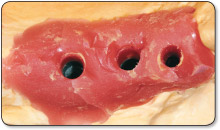
Integrated Abutment Crown™ (IAC): Impression Technique

Page 1 | Page 2 | Page 3 | Page 4 | Page 5 | Page 6 | Page 7 | Page 8 | Page 9 | Page 10 | Page 11 | Page 12

The Bicon Integrated Abutment Crown™ (IAC) is a cementless and screwless crown made possible by the 360˚ of universal abutment positioning of Bicon’s 1.5˚ locking taper implant-abutment connection. The IAC is made from a polyceramic material such as DiamondCrown™, which is 80% glass and 20% PEX resin. In detailed research, this material has proven to have better biomechanical properties than conventional restorations. The Integrated Abutment Crown™ begins with an implant level impression and the preparation of a chamfer margin on a non-shouldered or shouldered abutment. The abutment is then prepared, opaqued, and successive layers of the light cured polyceramic material are bonded directly onto the abutment to form the IAC. While other materials can be used for the buildup of an Integrated Abutment Crown™, at this time, DiamondCrown™ is the only material that Bicon has clinically tested.


Impression Technique

1. Remove temporary abutment, healing abutment, or transitional restoration and abutment.

2. If necessary, use an impression reamer (260-101-452 or 260-101-453) on a guide pin to widen the site for the insertion of an impression post.

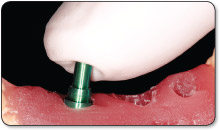
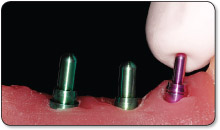
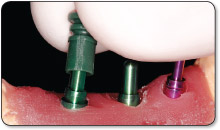
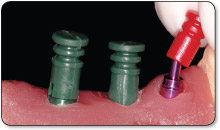
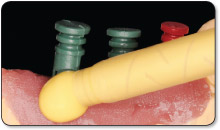
3. Tap the impression post into the implant well. Choose a red impression post for a 2.0mm well and a green impression post for a 3.0mm well.

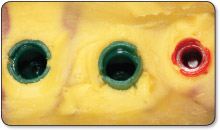
4. Inject impression material around the impression post. Seat the tray with impression material. Make impression being careful not to distort the impression post by overseating the tray. It may be neccessary to make a hole in the tray for the post.

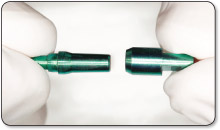
5. Remove the impression post from the implant and insert it into an implant analog.

6. Place the assembled impression post and implant analog unit into the impression. Inject soft tissue material around the post and minimally around the implant analog. Pour impression in dental stone.


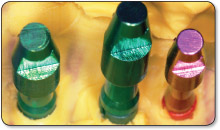
Note: An actual titanium abutment may be used in lieu of an impression post. The abutment must be fully tapped into the well of the implant when the impression is made. The abutment is then removed and assembled to an implant analog prior to being seated into the impression for the pouring of a stone model.


Keys to Success

It is highly recommended that the clinician first use this restoration somewhere in the mouth other than the maxillary anterior due to the significant influence of interproximal contacts and tissue interferences on the proper seating of an IAC.
• If necessary, use an impression reamer especially for deeply positioned implants.
• The impression post must be tapped into the well of the implant — it cannot be pushed or twisted into position.
• The impression post should not come out with the impression. If the impression post were to come out with the impression material, another impression must be made.
• Assemble the impression post and the implant analog outside of the impression prior to seating them as a unit into the impression.
• Use a titanium implant analog when application of heat is anticipated during the lab technique, e.g. soldering.
• Titanium implant analogs require the titanium abutment to be tapped into the implant analog to assure that the proper axial position is achieved during the fabrication of the final prosthesis.
• Carefully confirm complete seating of impression components.


Page 1 | Page 2 | Page 3 | Page 4 | Page 5 | Page 6 | Page 7 | Page 8 | Page 9 | Page 10 | Page 11 | Page 12